There’s a familiar rhythm to early-stage fintech success. The product launches. The corridors open. The growth charts point upward. But somewhere between the funding announcement and the next board deck, something quieter begins to crack.
Not the UI. Not even compliance, yet. It’s the payments.
More precisely, it’s the payment switching infrastructure underpinning the very payment product that begins to buckle under the weight of the very success it was supposed to support: transaction volume!
The problem with weak cross-border payment rails
In any typical cross-border payment product, as transaction volume climbs, what once looked like a working payment rail slowly reveals its true character. It either withstands the growing volume or breaks under the weight.
When a weak cross-border payment rail breaks, transactions are delayed in their hundreds or even thousands, reconciliation becomes a daily exercise in spreadsheet archaeology, and FX margins quietly erode. Operations teams grow faster than the business itself. Downtimes become a customer-facing incident that repels users.
None of these are product problems. They are faults of the underlying payment switching infrastructure almost always invisible to everyone until it’s expensive to fix.
But it begs the question of why payment switch infrastructure problems should still plague many payment systems today, when technology providers like FinCode have already solved them.
The answer? Many fintechs and banks still feel the need to engineer a custom payment switch, whether they have the technical capability to do so or not. That thinking costs real money if the in-house infrastructure built turns out to be weak under real payment processing conditions!
What an efficient payment switching platform ‘built for scale’ actually does

A true payment switching platform is not a transaction router. It is not a payment processor. It is not “just an API that moves money.”
At scale, it becomes the operational operating system for everything money-related in your business, and the difference between a platform built for hundreds of millions in transaction volume versus one that merely handles today’s load is not subtle. It shows up in the architecture long before it shows up in your incident reports.
An efficient platform at that level is making complex decisions in milliseconds, constantly. It is evaluating which payout partner to route a transaction through based on real-time availability, cost, and performance data, not yesterday’s configuration. It is applying FX logic that protects your margins on every single transaction, not just the ones your ops team remembered to check. It is reconciling across multiple partners, currencies, and time zones without a human being required to chase discrepancies at the end of the day.
And when something goes wrong, because at volume, something always goes wrong, it fails over automatically, reroutes without interruption, and keeps the customer experience clean while your team investigates in the background.
The distinction between switching and processing matters more than most founders realise. A processor asks: Can this payment go through? A switch asks: what is the best possible way for this payment to go through right now — and what happens if that route degrades in the next three seconds?
At low volume, that difference is inconsequential. With millions in transactions, it is the entire business.
Growth exposes everything your early infrastructure quietly ignored
Early-stage payment flows are forgiving. One corridor, one or two payout partners, low volume, and a small ops team that can still manage exceptions by hand. The cracks exist, they’re just small enough to step over.
Then growth happens, and the cracks become fault lines.
Suddenly you’re live in multiple corridors, each with different payout rules, different settlement cycles, and different partner reliability profiles. FX rates shift by route and by volume tier. Regulators want cleaner, more granular reporting. Customers, now in far greater numbers, want instant resolution when something goes wrong.
A switching platform built for scale absorbs this complexity without blinking.
It holds the routing logic centrally, so adding a new corridor doesn’t mean rebuilding payment flows from scratch. It tracks settlement obligations across partners automatically, so your finance team isn’t manually reconciling at month-end. It gives your operations team visibility into every transaction state in real time, so exceptions get caught before they become complaints.
Weak infrastructure does the opposite. It pushes every new layer of complexity onto humans. Operations becomes the switch. Finance becomes the reconciliation engine. Support becomes the incident desk.
Why cross-border payment rail failures are critical

Nowhere is the gap between adequate and excellent infrastructure more apparent than in cross-border expansion. Domestic payment flows are complex. Cross-border payment switching is a different discipline entirely.
Different settlement windows, multi-point currency conversions, partner-specific compliance requirements, time-zone-driven delays, and corridor-specific failure patterns. These variables multiply with every new market you enter. A platform designed for scale handles this through intelligent orchestration: routing logic that accounts for corridor-specific behaviour, FX engines that apply the right rate at the right moment, and compliance workflows that flex to meet each jurisdiction’s requirements without manual reconfiguration.
Without that foundation, every new corridor turns from an opportunity to generate revenue to a new failure point waiting for volume to expose it. This is why so many IMTOs and fintechs quietly “pause expansion” after their first successful corridor. The product works. The market exists. Their rails simply cannot keep up.
For African fintechs, this reality arrives faster and hits harder. Fragmented banking infrastructure, uneven partner reliability, sharp FX volatility, and regulatory diversity across borders put a heavier weight on any payment switch operating within Africa. A platform built for this context needs redundancy baked in at every layer, not bolted on after the first major incident.
Here, downtime is not a technical inconvenience. It is a reputational event. And at scale, reputational events are expensive in ways that no post-mortem fully captures. Africa customers DO NOT re-trust easily once money sent fails to deliver!
This is what Songhai Exchange was built for
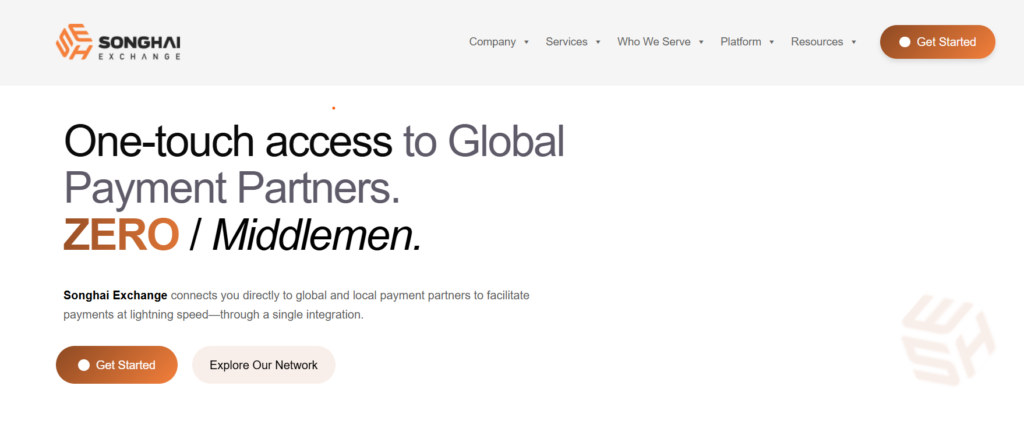
We’ve seen fintechs and banks struggle under the weight of cumbersome or simply weak payment switching systems. It’s one of the reasons why we built Songhai Exchange, our white-label, global payment switching solution.
It’s an infrastructure philosophy, built specifically for the growth pressures that African fintechs face, not the convenience requirements of early-stage operations.
At its core, Songhai Exchange functions as a payments orchestration platform that abstracts partner complexity, centralises routing logic, enables smart failover, preserves FX margins, and supports multi-corridor expansion without requiring teams to rebuild their payment logic every time a new market opens.
You build once. You scale safely. And you retain control over the margins that make the business worth scaling in the first place.
Rails decide outcomes before headlines do
Every founder wants growth. Few plan early enough for the operational weight that arrives with it.
The fintechs that scale 3x faster aren’t necessarily the ones with the best product or the most aggressive expansion strategy. They’re the ones whose infrastructure was ready when the volume arrived.
If you’re expanding corridors, increasing volume, or preparing for institutional-grade scale, now is the right time to make sure your payment rails are ready for the ambition behind them.Talk to FinCode about Songhai Exchange, whether you want to integrate directly or white-label the platform for your own network. We would be happy to show you the growth your payment product is capable of, with the right switching infrastructure underpinning it.