The Uncomfortable Truth About Fintech Success
If you open LinkedIn or visit a fintech online magazine or blog on a good workday, you would probably read about a fintech announcing “traction.” Dozens of fintechs announce this every year. Fewer announce profitability.
The gap between the two, traction and profit, is rarely branding, pricing, or even compliance complexities. More often, it’s an invisible fault line running underneath the product. The fintech infrastructure
Here’s what seasoned operators often learn: the success of a fintech venture goes beyond acceptance of the product; a key criterion is how well the product proves itself in the ecosystem.
This is especially true in remittance and cross-border payments, where early-stage teams unknowingly bet their entire roadmap on a single bank, a single corridor, or a single payout partner. When those dependencies strain or fail, the symptoms surface across the product: service interruptions, settlement delays, or routing limitations.
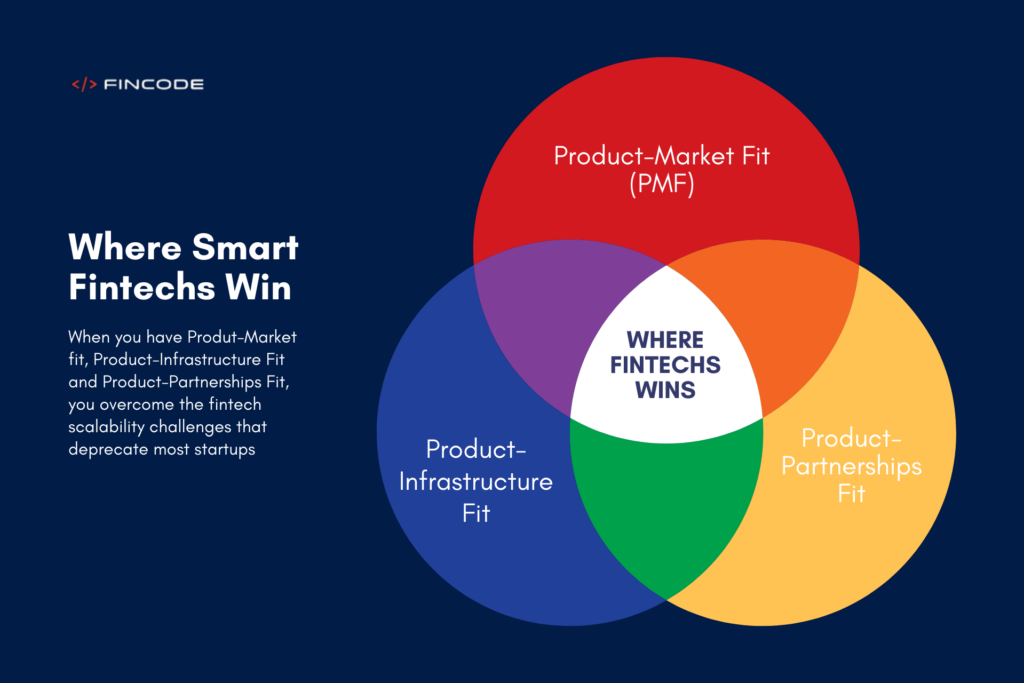
Traditional startup advice says “find product-market fit, then scale.” But that framework misses something critical in financial services. You need three distinct fits, not one: Product-Market Fit, Product-Infrastructure Fit, and Product-Partnerships Fit. And the latter two often determine whether you can validate the first.
In this article, we’ll explore what makes fintechs succeed before scale, why many struggle even after finding market traction, and how understanding these three fits separates fleeting growth from durable success.
Beyond Product-Market Fit: The Three Fits Framework
Fintech product market fit is not simply about demand meeting supply. In financial services, success requires three interdependent fits working simultaneously:
Product-Market Fit (PMF)
Does the market want what you’re selling? This is the traditional definition, which validates that real customers have a real problem your product solves and are willing to pay for it.
Product-Infrastructure Fit
Can your backend reliably deliver what you’re selling? This means your payment switching infrastructure, settlement systems, and technical architecture can handle transaction volume, maintain uptime, and support the product experience you’ve promised.
Product-Partnerships Fit
Do your banking partners, processors, and payout networks enable sustainable delivery? This covers whether your relationships with banks, correspondent networks, and service providers can support your growth trajectory and market expansion plans.
Achieving fintech product market fit requires all three fits, not just one. You can have strong market demand, but if your fintech infrastructure buckles under load or your partnership dependencies create bottlenecks, customers experience failure, and they attribute it to your product, not your backend.
The dependency relationship is critical. Product-Infrastructure Fit and Product-Partnerships Fit aren’t things you build after finding market fit. They’re often prerequisites for validating market fit in the first place. Without resilient payment rails for fintechs, every infrastructure failure or partnership limitation sends false signals about market demand.
A payment or remittance product can show strong early adoption and still lack real sustainability. Transactions may be flowing, users may be signing up, but underneath, the system could be fragile, overly dependent on third parties, or quietly hemorrhaging margin.
This is why fintech product market fit is harder to achieve and harder to maintain than in most other sectors. Financial products operate inside regulated environments, depend on external counterparties, and move real money in real time. A single failure isn’t a bug; it’s a breach of trust.
The Infrastructure Blind Spot: When Missing Product-Infrastructure Fit Affects Validation

Your average fintech team tends to obsess over the visible parts of the product: onboarding flows, pricing screens, notifications, and dashboards. These matter, but they’re rarely what breaks first.
The real risk sits in the fintech infrastructure layer that founders assume is “good enough” for now.
Early-stage decisions around cross-border payment infrastructure, payout partners, and settlement paths are often driven by speed to launch, not long-term signal integrity. One bank sponsor. One processor. One corridor. One route. It works, until it doesn’t.
The Single-Path Problem
This creates a dangerous blind spot during validation. When you lack Product-Infrastructure Fit, founders receive distorted feedback from the market:
- Service interruptions appear random, but they’re actually infrastructure capacity issues
- Corridor limitations look like weak market demand when they’re really architectural constraints
- Settlement delays feel like operational friction when they signal inadequate payment switching infrastructure
- Routing failures get classified as edge cases when they may reveal systemic design flaws
These are classic infrastructure mistakes fintech founders make, and they contaminate the market feedback loop. Teams end up iterating on features or pricing while the real constraint sits in their payment routing in fintech and core architecture.
The hidden cost isn’t just downtime or customer frustration. It’s lost learning velocity.
If you can’t quickly test new corridors, compare providers, or reroute transaction volume, you can’t answer basic validation questions with confidence:
- Is this market unresponsive, or unreachable through our current infrastructure?
- Is churn pricing-related, or reliability-driven?
- Is transaction volume capped by demand, or by our rails?
This is where fintech backend systems quietly determine whether a product ever reaches clarity. Without resilient remittance infrastructure and intelligent routing, experimentation becomes expensive, slow, and misleading. You’re flying blind.
The Bank for International Settlements has repeatedly highlighted how dependency on narrow payment pathways increases systemic and operational risk for cross-border services, a risk that startups feel first and hardest.
A second common infrastructure mistake fintech founders make is treating their initial technical setup as “temporary” infrastructure that they’ll upgrade later. But here’s the problem: by the time “later” arrives, the entire product validation is built on quicksand. Migration becomes a complete rebuild rather than an evolution.
The irony is that many founders only confront this blind spot after they believe they’ve found market fit, when scaling forces them to rebuild the very foundation on which they validated the product.
When Partnership Shapes Perception: Understanding Dependency Risk
Even with a strong Product-Infrastructure Fit, your fintech can still fail without a Product-Partnerships Fit.
This is the constraint most teams underestimate until it’s too late. Early-stage fintechs often launch with what seems like a pragmatic partnership approach: one bank sponsor, one payout partner, one primary processor. It’s simple, low-cost, and gets you to market fast. But it creates fragility that disguises itself as market feedback.
Why Single Dependencies Create False Signals
When you rely on a single bank or processor, every limitation in that relationship looks like a product or market problem:
- Geographic restrictions from one partner appear as “low demand in that corridor” when it’s really just partnership coverage gaps
- Volume caps from one processor feel like natural growth plateaus when they’re artificial ceilings
- Compliance requirements from one bank seem like industry standards when they might be outliers
- Pricing constraints from one partner look like market-rate realities when better economics exist elsewhere
Without Product-Partnerships Fit, you can’t distinguish between actual market rejection and partnership-imposed constraints. This is especially critical for payment routing in fintech and cross-border payment infrastructure, where corridor economics and partner capabilities vary dramatically.
Scaling Beyond Early Success
Here’s why fintechs struggle after product market fit: market validation often happens faster than partnership infrastructure can scale.
You prove demand exists. Users sign up. Transaction volume grows. But your single-partner setup becomes a bottleneck:
- Capacity limitations: Your partner can’t handle increased volume without degraded performance
- Regulatory strain: As you scale, compliance requirements multiply, but your partner’s systems weren’t built for your volume
- Economic pressure: Early partnership terms that worked at low volume become unsustainable at scale
- Expansion friction: Adding new corridors requires renegotiating or onboarding entirely new partners from scratch
By the time these constraints surface, you’ve already validated demand. But now you’re limited: rebuild your entire partnership layer while maintaining service, or watch growth stall.
The Hidden Cost of Partnership Dependency
Beyond operational constraints, single-partner dependencies create strategic risk:
- Negotiation leverage evaporates: When you’re locked into one provider, pricing negotiations favor them
- Innovation stalls: You can only move as fast as your slowest partner allows
- Geographic expansion becomes binary: New markets require entirely new partnership deals rather than incremental expansion
- Resilience disappears: Partner outages become your outages, with no failover or redundancy
Achieving Product-Partnerships Fit means building a partner ecosystem that enables experimentation, provides redundancy, and scales economics alongside volume. It’s not about having dozens of partners on day one. It’s about having the architecture to add, test, and optimize partners without rebuilding your product.
What Successful Fintechs Do Differently: Building All Three Fits from Day One
Top-performing fintechs separate product validation from backend and partnership constraints from the very beginning. They understand that what makes fintechs succeed isn’t just finding market demand, it’s building infrastructure and partnerships that can validate and scale that demand simultaneously.
Achieving Product-Infrastructure Fit
Companies that nail Product-Infrastructure Fit implement scalable fintech architecture with these core principles:
Redundant routing paths: Multiple processors, settlement paths, and payout options prevent single points of failure. When one path experiences issues, transactions automatically route through alternatives without service disruption.
Intelligent payment switching infrastructure: Rather than static routing, successful fintechs implement orchestration layers that make real-time decisions based on cost, speed, FX margins, corridor availability, and partner reliability. This is the fundamental difference in payment switching vs payment gateway models.
Decoupled infrastructure layers: Product and feature testing operate independently of transaction settlement systems. This means you can experiment with pricing, user flows, and corridor selection without risking core payment reliability.
Built-in compliance architecture: Automated AML/CFT monitoring, transaction reporting, and audit trails are embedded in the fintech backend systems from day one, not bolted on later.
This approach to payment routing in fintech enables rapid corridor testing, provider comparison, and volume rerouting, all without compromising reliability or customer experience.
Achieving Product-Partnerships Fit
Equally important, what makes fintechs succeed is strategic partnership architecture:
Multi-partner orchestration: Instead of committing to a single bank or processor, successful fintechs build integration layers that support multiple partners simultaneously. This provides negotiation leverage, operational redundancy, and faster expansion.
Flexible onboarding processes: New partners can be integrated and tested in parallel with existing relationships, allowing for A/B comparison of economics, performance, and compliance requirements.
Corridor-specific optimization: Different markets and payment corridors have different optimal partners. Scalable fintech architecture allows routing intelligence to select the best partner per transaction, not per company.
Partnership performance monitoring: Real-time dashboards track partner uptime, settlement speed, success rates, and cost per corridor, enabling data-driven optimization rather than gut-feel decisions.
The Combined Effect: Overcoming Fintech Scalability Challenges
When you have both Product-Infrastructure Fit and Product-Partnerships Fit, you overcome the fintech scalability challenges that deprecate most startups:
- Testing becomes cost-effective and fast: New corridors, pricing models, and partners can be validated in days or weeks, not quarters
- Reliability becomes a competitive advantage: Redundancy and intelligent routing mean higher success rates and better customer experience
- Economics improve with scale: Multi-partner competition drives better pricing, and intelligent routing optimizes margins per transaction
- Regulatory compliance scales smoothly: Built-in monitoring and reporting capabilities handle increased volume without manual intervention
- Geographic expansion accelerates: Adding new markets doesn’t require infrastructure rewrites or lengthy partnership negotiations.
Why This Framework Matters

Traditional startup advice treats infrastructure and partnerships as implementation details you figure out after finding market fit. In fintech, that’s behind. Infrastructure mistakes fintech founders make in the early days create false signals that corrupt market validation. Partnership constraints disguised as market limitations lead teams to abandon viable opportunities.
The companies that succeed build for all three fits from the beginning. They recognize that cross-border payment infrastructure and scalable fintech architecture aren’t technical concerns to delegate. They’re strategic decisions that determine whether you can validate markets accurately and scale sustainably.
FinCode’s Role: Enabling All Three Fits from Day One
This is where FinCode helps credible fintechs and banks achieve Product-Infrastructure Fit and Product-Partnerships Fit alongside traditional market validation.
We’ve proven this approach through successful implementations with RemitJunction, FCMB, First Bank of Nigeria, WorldRemit, Sendwave, and others who’ve built market-winning products on our platform.If your team is validating markets, testing corridors, or scaling cross-border services, the question isn’t whether you need all three fits; it’s how quickly you can incorporate them. Consider partnering with FinCode for infrastructure and partnerships that accelerate validation rather than slow it down.